Maddie Whitby Design

It’s hard to pin point who I am inspired by most and who influences my work as I have a very broad range of mediums and styles. The reason I don’t have a consistency in my work is because I love exploring different art mediums and combining them with design which best reflects the current concept I have drawn from, from the brief. I am therefore constantly getting new influences from different artists and designers to inspire my work. I am also generally inspired by the world around me and always get the opportunity to reflect what I’ve recently learnt about a random topic in my current project. 

At this stage I think the main idea of what type of designer I am or what designer I might become will encompass the concept ‘collaboration’. That could involve the collaboration of art mediums, art with design, design practices, people or concepts. 

Projects

This is a loom weaving which was inspired by a women by the name of Juliane Koepcke who I had recently learnt about on a podcast. Juliane was dropped into the amazon jungle of Peru after a plane wreckage and survived the landing and 10 days in the jungle with no food, water, supplies or glasses, which she heavily relied on. 1 The brief was to represent any person that you admired in either a CD cover, a poster or a website. The art medium of loom weaving was inspired from my recent trip to Oaxaca in Mexico so I attempted to represent a jungle landscape through this medium.

There were many talented artists who I drew inspiration from but one that particularly inspired me for this project were Lauren and Kass Hernandez who are an Australian sister duo based in Sydney. 2 They launched their ‘brand’ crossing threads in 2015 and celebrate the revival of the handmade through their highly textural and more modern wall hangings. Their work embraces nature and more specifically Australian landscape that surrounds them. 3

This cotton tree installation was inspired by ‘off-the-grid’ living. I had recently started learning more about sustainability and watched a documentary about living off-the-grid. I chose to create a cotton tree installation as cotton is the most widely used natural fibre cloth in clothing today. Because of cotton’s biodegradable properties, all-cotton clothing and materials can also be recycled and used in the manufacture of useful materials. Therefore, I chose it to represent ‘off-the-grid’ living as I thought it was very fitting.

I drew a lot of inspiration for this work from the installation artist Rebecca Louise Law. Law is best known for her creations with natural materials such as flowers. 4 She blurs the lines between the artwork and the audience by creating the installation so the viewer can become involved in it by walking so closely underneath it and through it.

Most of my work I have completed (above) has some form of tactile element which I think reflects the person I am. I don’t want to be a designer who sits behind a computer everyday because I’ve found that’s not what motivates me.

In a world that is moving to all digital mediums I think we are losing the personal touch which is what makes us human. I think if we combine the two we will be able to connect to the audience on a different level.

Further reading about in reference to crossing the boarders between art and design. ‘Transformation of the Aesthetic: Art as Participatory Design’. 5

MaddieWhitby
  1. Do go on, podcast. https://www.planetbroadcasting.com/our-shows/do-go-on/.

2. My modern met. https://mymodernmet.com/fiber-art-woven-wall-hangings- crossing-threads/ (accessed April 5th 2019).

3. Crossing threads. https://crossingthreads.co/about (accessed April 5th 2019).

4. rebeccalouiselaw. https://www.rebeccalouiselaw.com (accessed April 5th 2019).

5. Matthew Holt (2015) Transformation of the Aesthetic: Art as Participatory Design, Design and Culture, 7:2, 143-165, DOI: 10.1080/17547075.2015.1051781

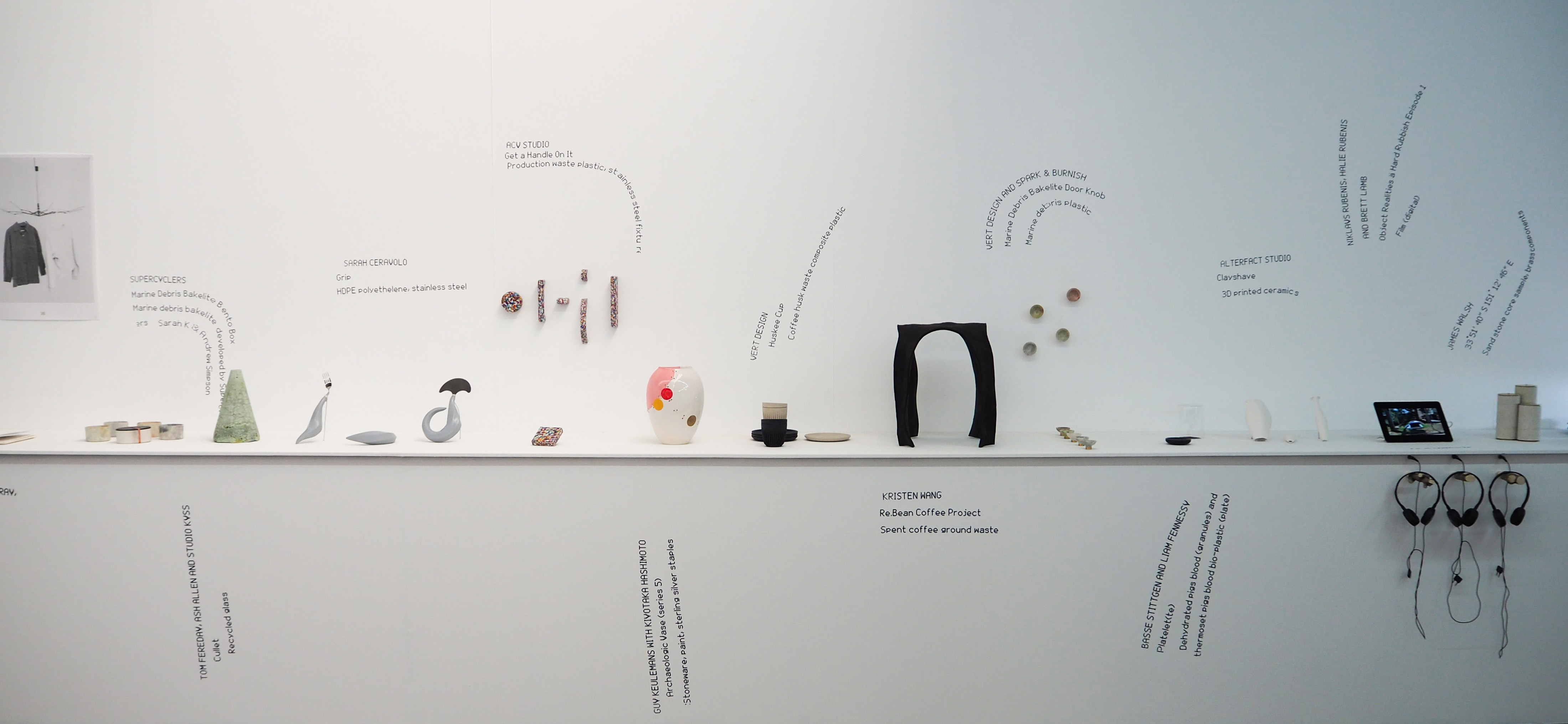
Welcome to Wasteland

‘Waste is just raw material with a bad name’.

Welcome to Wasteland showcases projects from all areas of creative disciplines including architects, industrial designers, furniture makers and researchers and explores ‘the use of waste materials, offering visitors an insight into how leading practitioners are approaching Australian waste issues, not just with a sense of obligation but as an opportunity of crisis.’ 1

The exhibition was launched on the 22nd of March as part of NGV’s design week and I arrived at the exhibition on the first day of design week so I was pleased to see it was really quiet. I got the opportunity to be taken around the exhibition individually by someone who could explain all the artworks for me and could therefore ask questions. It turned into more of a conversation between her and I, instead of just being spoken to about the work which was great because I ask lots of questions!

Everything considered

The Exhibition as a whole was considered of how it could be run most sustainably. The artists name and art descriptions were printed by a print on ‘gun’ appliance instead of using plaques or stickers. They definitely took advantage of the technique by curving the text and making patterns which you couldn’t do as freely with plaques or stickers. 


A large solar panel was also situated outside of the exhibition before you walked inside which generated power to run the exhibitions website.  

The remaining materials leftover from the art pieces were also not ignored as they were collected to create another artwork in the middle of the exhibition.

Artwork

‘A discrete infinity’

The artists that really pushed my thinking around waste were Matt Lenz and Paul Mylecharane (Public Office) 3 who designed a small but radical installation together called ‘A discrete infinity’ about technological waste. 


  • When you walk into the exhibition there is only silence and the sound of a very small monitor beeping. The beep is recording every time someone’s phone in a small radius either gets a notification from social media or a text message. To show a visual representation to support this there is also a screen behind the monitor recording the beeps. I think the artists really pushed the boundaries in considering what is ‘waste’ and to cause further questions around what is ‘waste’. 

Materials:

Chromium Browser, Networked Raspberry Pi, Mac Mini and Open Source Code

“Each moment we spend interacting with our personal devices, we secrete. Much like spiders, we are weaving webs that map our daily movements, our interactions, spending habits and predispositions. ‘A Discrete Infinity’ is a durational, generative artwork momentarily responding to the chirping of the network; to the ephemeral footprint we leave behind unknowingly.” 5


The creatives included in the exhibition were either already practicing sustainability or were asked to create something new for the exhibition. The exhibition asked me to consider things that I wouldn’t have normally considered that contribute to waste and inspired me to design my own sustainable object for my current sustainability project.

Follow the link to further explore the artworks to see how they have used unusable materials in there work to create everyday useable items in their attempt to compete with the world of over consumerism which is the leading cause for our natural environment disappearing. 4

http://solar.friendsand.associates/chromium-browser-networked-raspberry-pi-mac-mini-and-open-source-code/ 5

.

  1. NGV,. Welcome to Wasteland. https://www.ngv.vic.gov.au/program/welcome-to wasteland/. (accessed April 2nd, 2019).

2. The ‘Waste is just raw material with a bad name’ quote was said someone who ran the exhibition and then repeated to me by the person who explained all the projects in the exhibition.

3. Public office. https://public-office.info (Accessed April 6th, 2019)

4. de Blas, Alexandra. “Making the shift: from consumerism to sustainability.” Ecos, Feb.-Mar. 2010, p. 10. Academic OneFile, http://link.galegroup.com.ezproxy.lib.monash.edu.au/apps/doc/A223748661/AONE?u=monash&sid=AONE&xid=c4998886. Accessed 11 Apr. 2019.

5. Solar friends and associates. http://solar.friendsand.associates/chromium- browser-networked-raspberry-pi-mac-mini-and-open-source-code/. (accessed March 26th, 2019.)