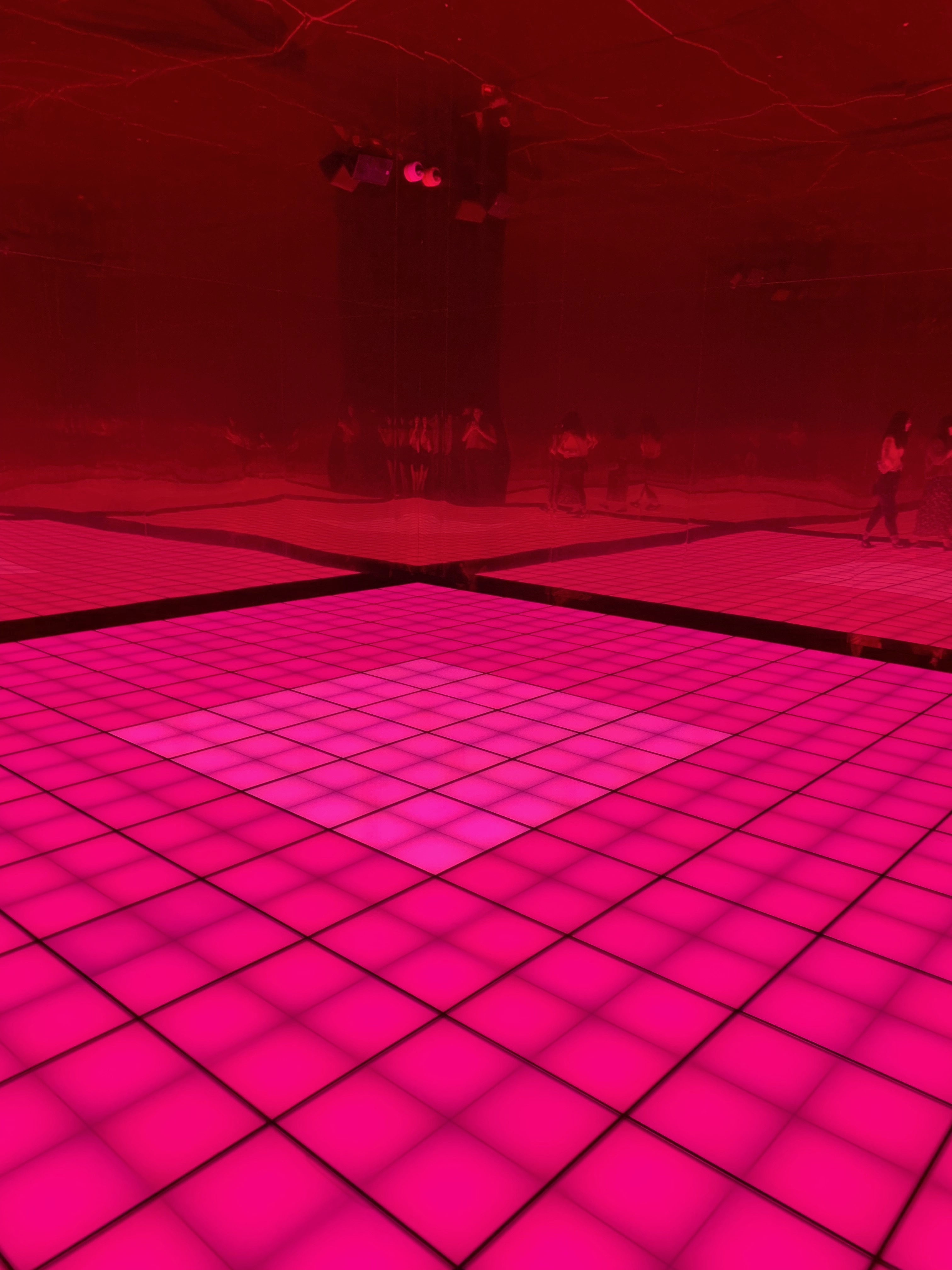
On Saturday I went to the NGV with the intention of visiting an exhibition about Aboriginal art. After going to that exhibition I was impressed by the artwork but wasn’t too engaged. Then, as I was about to leave the museum, I heard music. This instantly attracted my attention. From the moment I got near to the exhibition I was intrigued, I didn’t know what I was entering as there wasn’t much signage. As I walked closer the music got louder and louder, then I started to recognise some pictures that were displayed – it was an exhibition on Darren Sylvester. Before I had an in depth look at his artwork, I immediately went to what caught my attention initially – the music. In the exhibition area I entered through a white door where the music and some red lights were shining out of. I had entered a mirrored room with light up floors that reminded me of a retro disco floor. I didn’t entirely understand what I was looking at, but it was very intriguing, with the bright lights mesmerising, almost hypnotising my vision and those around me. Jake Barton, founder of Local Projects, highlights that people “want to express themselves and see their own identity refracted through the museum’s” (Barton, 2014) , implying that people want to engage with museum exhibitions in a way that can reflect who they are. This is very applicable in many of Sylvester’s museum exhibits. Sylvester focuses a lot of his artworks on attracting many different senses within viewers, rather than just the visual that is used in every piece of art. He breaks out of what the standard type of artwork is and attempts to delight the viewer in more different and engaging ways. In doing so, he “breaks down the fourth wall of design” (Solis, 2016) and partakes in something that Matthew Holt, Design Program Manager at the University of Sydney, refers to as Participatory Design. This refers to the collaboration of all people within the design process, not just the end user. In this case, the act of the viewer collaborates and partakes in the audio and visual aspects of the disco room, ultimately making them part of the exhibition itself.
Furthermore, Carl DiSalvo’s writings ‘Design and the Construction of Publics’ explores how the public is influenced and affected by it’s own political state. He states that “the public is an entity brought into being through issues for the purpose of contending with these issues in their current state” (DiSalvo 2009, 49), highlighting the myriad of difficulties that arise within a contemporary society. This directly correlates with many of Sylvester’s artworks. In particular, his work titled ‘Broken model’. This photograph is a reenactment of a moment from Jean Paul Gaultier’s fashion show where a model had, initially unknown to Sylvester, fallen deliberately. His recreation to this enlightened viewers about “empathy, lack of authenticity and fashion desirability” (Sylvester).
Overall, I really enjoyed this exhibition. The many different interactive and reflective ideas it portrayed really stood out to me.

Bibliography
Jake Barton, An ingenious museum design that turns visitors into creators. Accessed April 10, 2019. https://www.wired.com/2014/06/a-design-museum-that-turns-its-visitors-into-designers/
Brian Solis, Break the fourth wall to transform customer experience. Accessed April 10, 2019. https://relate.zendesk.com/articles/breaking-fourth-wall-customer-experience/
Disalvo, Carl. 2009. Design and the Construction of Publics. Massachusetts: MIT
Sylvester, Darren. 2019. CARVE A FUTURE, DEVOUR EVERYTHING, BECOME SOMETHING. NGV